Hotels and hospitality properties face a unique fire safety challenge: they must protect people who may be unfamiliar with the building, while managing kitchens, restaurants, laundry areas, plant rooms, guest rooms, electrical equipment and other higher-risk spaces.
For hotel operators in Abu Dhabi, effective fire protection is therefore about more than installing alarms and extinguishers. Systems must be appropriately designed, maintained, tested and integrated so that a fire can be detected quickly, controlled effectively and communicated to occupants.
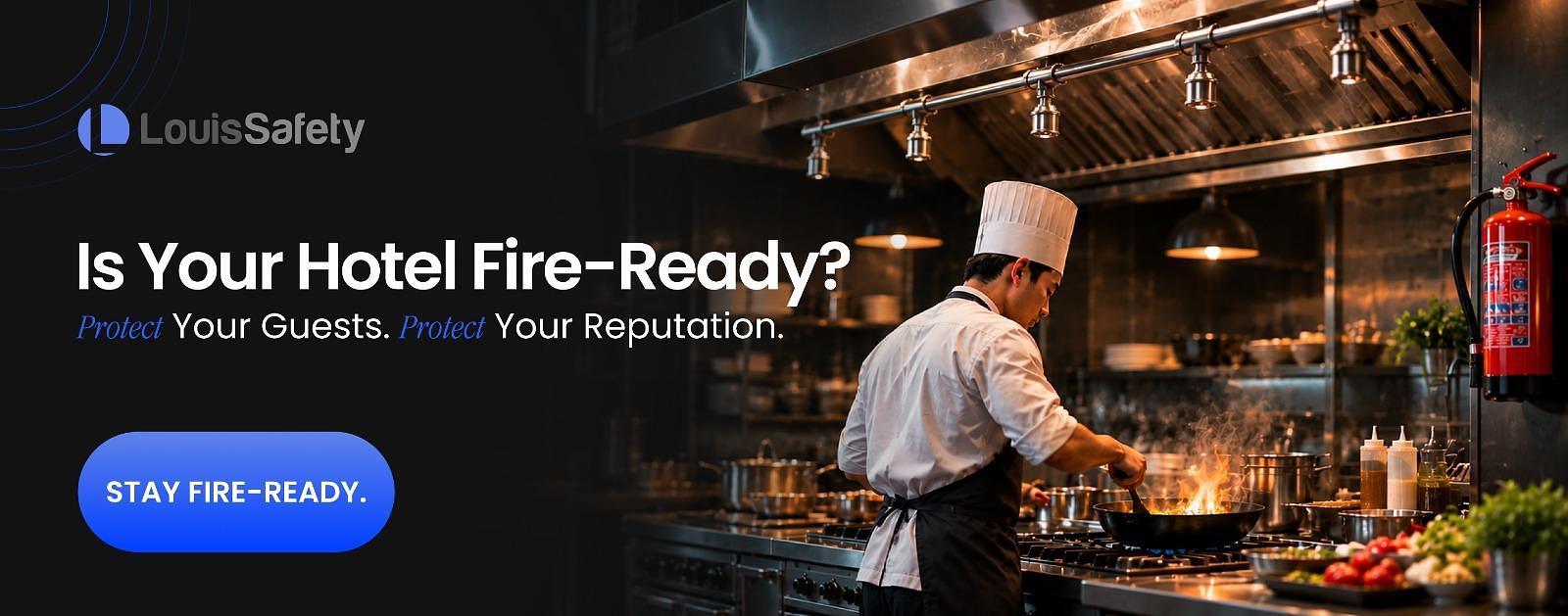
This is particularly important in commercial kitchens, where cooking oils, grease deposits, open flames and high-temperature equipment can create a serious fire risk.
Understanding hotel fire safety compliance in Abu Dhabi means looking at the entire property as one interconnected life-safety system—from the kitchen hood suppression system to fire alarms, emergency lighting, escape routes and smoke control.
Why Fire Safety Is Critical in Hotels
Hotels operate around the clock and accommodate guests with different levels of familiarity with the property.
A typical hotel may contain:
- Guest bedrooms and suites
- Restaurants, cafés and commercial kitchens
- Laundry and housekeeping areas
- Electrical and mechanical rooms
- Storage and waste areas
- Parking facilities
- Function and conference spaces
- Back-of-house service areas
- Plant and utility rooms
A fire in one area can quickly affect other parts of the building through smoke, heat and service penetrations.
Abu Dhabi Civil Defence Authority (ADCDA) is responsible for preventive safety requirements across residential, commercial and industrial establishments and oversees inspections to verify compliance with applicable safety requirements.
For hotels, this makes ongoing fire protection system performance an operational priority—not simply a compliance exercise.
Key Areas of Hotel Fire Safety Compliance in Abu Dhabi
A strong hotel fire safety strategy should consider several systems together rather than treating each installation separately.
Fire Detection and Alarm Systems
Fire alarm systems provide the early warning needed to initiate an appropriate response.
Depending on the hotel's design and risk profile, the system may incorporate:
- Smoke and heat detection
- Manual call points
- Fire alarm control panels
- Audible and visual notification devices
- Fire alarm interfaces
- Monitoring and communication systems
- Interfaces with smoke management and other building systems
Fire alarm systems should be correctly designed for the building layout and maintained so that faults, damaged devices or outdated equipment do not compromise detection.
For complex buildings, fire alarm interfaces can also trigger critical functions such as equipment shutdown, door release, elevator recall and smoke-management functions. UAE fire-safety guidance includes these types of automatic interfaces as part of integrated fire alarm operation.
Emergency Evacuation Systems
Hotel guests may not know the location of staircases, fire exits or assembly areas.
This makes clear evacuation arrangements particularly important.
Emergency systems can include:
- Emergency lighting
- Exit signs
- Fire alarm notification
- Voice evacuation systems where applicable
- Clearly protected escape routes
- Fire-rated doors and compartmentation
- Smoke control and stairwell pressurisation
- Accessible emergency exits
The objective is to provide occupants with a safe and understandable route away from danger.
Emergency voice evacuation systems can be particularly valuable in large or complex buildings because emergency announcements can communicate instructions across different areas of the property. UAE fire-safety guidance recognises emergency voice evacuation as an important component of life-safety systems in applicable buildings.
Kitchen Hood Suppression for Hotels
One of the most important specialist fire protection systems in a hotel is often found above the cooking equipment.
Commercial kitchens contain concentrated fire hazards from cooking oils, grease, gas and high-temperature appliances. A conventional portable extinguisher alone is not an adequate substitute for a properly designed fixed suppression system.
What Is a Kitchen Hood Suppression System?
A kitchen hood suppression system is designed to detect and suppress fires associated with cooking appliances and the extraction hood and ductwork.
A properly engineered system may protect areas such as:
- Deep-fat fryers
- Grills
- Ranges
- Cooking surfaces
- Ovens
- Extraction hoods
- Grease filters
- Exhaust ductwork
The system is designed around the actual cooking equipment and configuration rather than simply treating the kitchen as a standard room.
Why Kitchen Hood Suppression Matters in Hotels
A kitchen fire can escalate rapidly, particularly when combustible grease deposits are present within extraction systems.
An effective suppression system can help:
- Detect a fire at the cooking line.
- Activate the suppression system.
- Discharge the appropriate extinguishing agent.
- Control the fire at its source.
- Shut down associated fuel or equipment where designed.
- Reduce the possibility of fire spreading through the extraction system.
The system must also be correctly maintained. Changes to cooking equipment, hood configuration or kitchen layout can affect the original protection arrangement.
Kitchen Extraction Systems Need Attention Too
Kitchen fire protection does not stop at the suppression cylinders or discharge nozzles.
Extraction hoods, filters and ductwork can accumulate grease over time. This creates an additional fire hazard and can affect the effectiveness of the overall system.
Regular inspection should consider:
- Hood condition
- Grease accumulation
- Filters
- Ductwork
- Suppression nozzles
- Detection components
- Agent cylinders
- Release mechanisms
- Fuel shut-off interfaces
- System condition after modifications
UAE fire-safety emergency guidance specifically highlights the importance of checking oven hoods and ventilation equipment in facilities containing kitchens.
Guest Safety and Evacuation: What Hotels Need to Consider
Hotel evacuation is different from evacuating a familiar workplace.
Guests may:
- Be asleep when an alarm activates
- Be unfamiliar with exit routes
- Have mobility limitations
- Speak different languages
- Be located several floors away from the incident
- Initially mistake an alarm for a false alarm
For this reason, fire protection design should support fast detection, effective notification and clear escape routes.
Fire Doors and Compartmentation
Fire-rated walls, doors and protected service penetrations help prevent fire and smoke from spreading between areas.
Hotels have numerous services passing through walls and floors, including electrical cables, pipes and ventilation systems. Poorly protected penetrations can compromise otherwise effective fire compartments.
Emergency Lighting and Exit Signs
During a fire, normal power may be interrupted or visibility may be reduced by smoke.
Emergency lighting and illuminated exit signs help occupants identify escape routes and exits when normal lighting is unavailable.
Fire Protection Systems Must Work Together
A modern hotel should not view each fire safety system as an isolated installation.
For example, when a fire is detected, several actions may need to occur depending on the approved building design:
Detection → Alarm → Notification → Equipment Interface → Smoke Management → Evacuation
This may involve the fire alarm system communicating with:
- HVAC systems
- Smoke extraction
- Stairwell pressurisation
- Elevators
- Access-controlled doors
- Kitchen equipment
- Fuel supplies
- Emergency systems
This integrated approach helps ensure that one system supports the operation of another.
Common Hotel Fire Safety Problems
Several issues can gradually reduce the reliability of a hotel's fire protection systems.
1. Outdated Fire Alarm Components
Older panels, detectors or notification devices may become difficult to source or maintain.
2. Kitchen Modifications
Changing cooking equipment without reviewing the existing suppression system can create protection gaps.
3. Poorly Maintained Suppression Systems
Expired components, damaged nozzles, pressure issues or incorrect system configuration can affect performance.
4. Blocked or Altered Escape Routes
Furniture, storage or temporary installations can reduce the effectiveness of designated escape paths.
5. Inadequate System Integration
A fire alarm system that does not properly interface with required building systems can compromise the intended emergency response.
6. Deferred Maintenance
Small faults can become significant problems when inspections and corrective maintenance are repeatedly delayed.
Hotel Fire Safety Inspection Checklist
Hotel operators should regularly review the condition and operation of:
- Fire alarm systems
- Smoke and heat detectors
- Manual call points
- Notification appliances
- Emergency lighting
- Exit signs
- Fire doors
- Fire-rated barriers
- Sprinkler systems
- Fire pumps
- Hose reels and extinguishers
- Kitchen hood suppression systems
- Kitchen extraction systems
- Smoke control systems
- Stairwell pressurisation
- Emergency power supplies
- Fire alarm interfaces
The exact inspection and maintenance requirements should always be based on the approved system design, applicable codes, manufacturer requirements and authority requirements.
How to Improve Hotel Fire Safety Compliance in Abu Dhabi
A practical approach is to treat fire safety as a continuous lifecycle rather than a one-time installation.
Step 1: Assess the Existing Systems
Identify defects, obsolete equipment, coverage issues and areas affected by building modifications.
Step 2: Review High-Risk Areas
Pay particular attention to kitchens, electrical rooms, storage, laundry areas, plant rooms and other areas presenting elevated fire risks.
Step 3: Check System Integration
Verify that fire detection and alarm systems correctly interface with the building functions required by the approved design.
Step 4: Address Deficiencies
Prioritise issues that could affect detection, suppression, evacuation or fire containment.
Step 5: Maintain the Systems
Planned inspection, testing and maintenance help keep fire protection systems operational and reduce unexpected failures.
ADCDA provides services for the issuance and renewal of Certificates of Compliance with Preventive Safety Requirements, reinforcing the importance of maintaining compliance for establishments in Abu Dhabi.
Follow Louis Fire Safety on LinkedIn for fire safety updates, project news, and Civil Defence compliance guidance across Abu Dhabi.
Conclusion
Hotel fire safety requires a coordinated approach that protects guests, employees, property and business operations. From kitchen hood suppression and fire detection to emergency evacuation, smoke control and ongoing maintenance, every component has a role to play.
For hotel operators, the best time to identify weaknesses is before an emergency exposes them.
Louis Fire Safety provides professional fire protection solutions for commercial properties, helping hotel and hospitality operators assess, maintain and improve critical fire safety systems.
Is your hotel’s fire protection system ready for its next inspection or emergency? Contact Louis Fire Safety today to arrange a professional assessment and identify the right fire safety solutions for your property.