Fire Safety Begins Long Before an Emergency
Fire incidents can occur without warning, but the level of damage they cause often depends on how well a building has been designed to resist the spread of fire. While fire alarms, sprinklers, and extinguishers play a crucial role in responding to a fire, they represent only one aspect of a comprehensive fire protection strategy.
Equally important is Passive Fire Protection (PFP)—a collection of fire-resistant systems and construction methods that work continuously to slow the spread of flames, smoke, and heat. Unlike systems that activate during an emergency, passive fire protection is permanently integrated into the building, providing protection every minute of every day.
Modern commercial buildings, industrial facilities, hospitals, hotels, warehouses, educational institutions, offshore installations, and energy plants all rely on passive fire protection to improve life safety, protect structural integrity, and maintain business continuity.
As industries continue to develop larger and more complex infrastructure, Passive Fire Protection has become one of the most important investments in long-term fire safety and regulatory compliance.
What is Passive Fire Protection?
Passive Fire Protection (PFP) refers to fire-resistant materials, products, and building systems that are designed to contain fire within a designated area, preventing it from spreading rapidly throughout a structure.
Unlike active fire protection systems that require detection, electricity, water, or manual operation, Passive Fire Protection works automatically without any external activation.
Its primary objective is to maintain the fire resistance of a building while allowing occupants sufficient time to evacuate safely and emergency responders adequate time to control the incident.
Passive Fire Protection helps to:
- Slow the spread of fire
- Restrict smoke movement
- Protect structural steel
- Preserve fire-rated compartments
- Maintain safe escape routes
- Reduce damage to property
- Improve emergency response effectiveness
- Support business continuity
These systems remain operational throughout the lifespan of a building, silently protecting people and assets even when no fire is present.
Why Passive Fire Protection Matters
A fire can spread within minutes through service penetrations, ceiling voids, cable trays, ductwork, and unprotected structural openings. Without adequate passive protection, flames and smoke can quickly move beyond the area where the fire originated, significantly increasing the risk to occupants and emergency responders.
Passive Fire Protection is designed to interrupt this spread by creating fire-resistant barriers that contain the incident within a limited area.
This additional containment time provides several important advantages:
- More time for occupants to evacuate safely
- Better access for firefighters
- Reduced structural damage
- Protection of critical equipment
- Lower financial losses
- Faster recovery after an incident
- Improved operational resilience
For high-risk sectors such as Oil & Gas, Marine, Energy, Manufacturing, Healthcare, Commercial Buildings, and Data Centres, Passive Fire Protection plays a critical role in protecting operations where downtime can result in substantial financial and operational consequences.
The Role of Passive Fire Protection in Modern Construction
Today's buildings contain extensive electrical systems, communication networks, HVAC services, plumbing, and mechanical installations. Every opening created for these services has the potential to compromise a building's fire resistance if left unprotected.
Passive Fire Protection restores the integrity of these fire-rated barriers through engineered solutions such as fire stopping systems, fire-resistant sealants, fire doors, structural fireproofing, and compartmentation.
Rather than reacting to a fire, Passive Fire Protection is designed to control how the fire behaves, limiting its spread and protecting the overall stability of the structure.
As building regulations continue to evolve, Passive Fire Protection has become a fundamental component of modern construction, helping designers, contractors, and facility owners create safer environments that meet both regulatory and operational requirements.
Passive Fire Protection vs Active Fire Protection
Although both systems contribute to fire safety, they perform different but complementary functions.
Passive Fire Protection is built into the structure of a building and continuously works to contain fire and smoke. Active Fire Protection systems detect, alert, suppress, or extinguish fires after they occur.
| Passive Fire Protection | Active Fire Protection |
|---|---|
| Built into the building | Activates during a fire |
| Always operational | Requires activation |
| No power required | May require electricity or water |
| Contains fire and smoke | Detects and suppresses fire |
| Protects structural integrity | Reduces fire intensity |
| Supports safe evacuation | Assists emergency response |
A comprehensive fire safety strategy combines both systems to provide multiple layers of protection.
Core Passive Fire Protection Systems
Fire Stopping Systems
Fire stopping is one of the most critical elements of Passive Fire Protection.
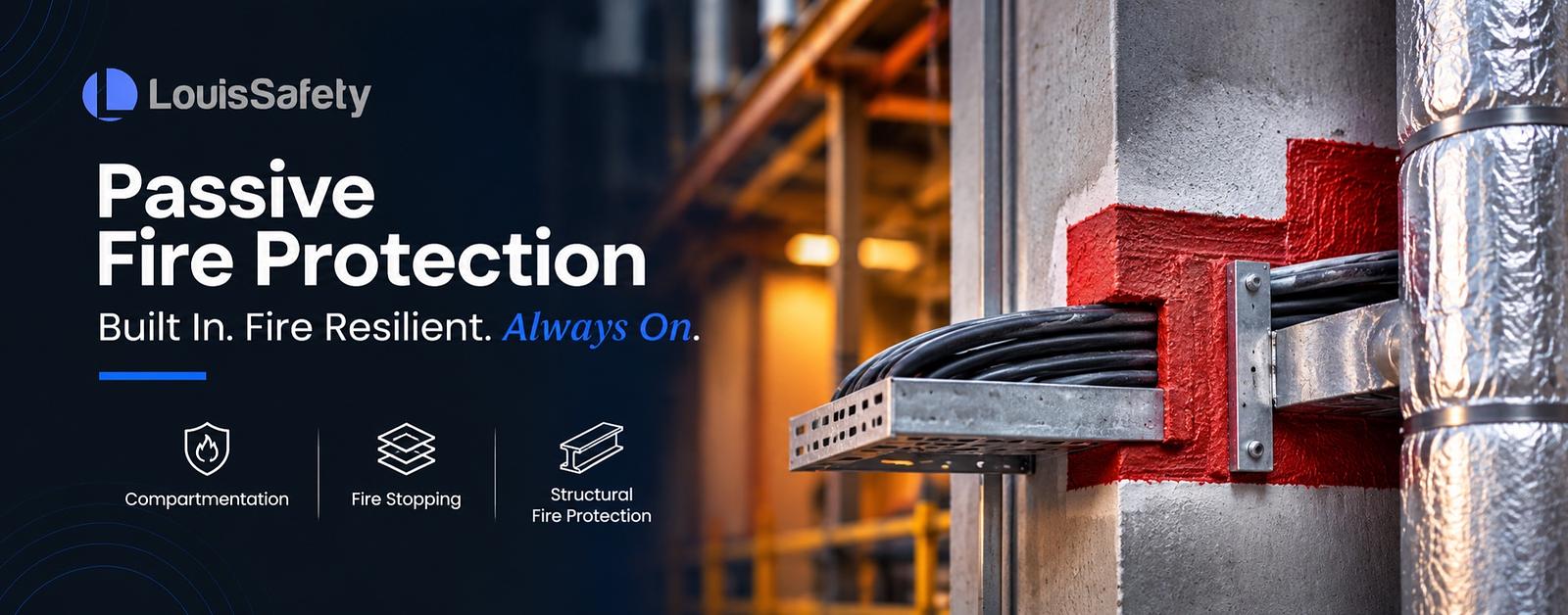
Whenever electrical cables, plumbing pipes, HVAC ducts, or communication systems pass through fire-rated walls or floors, openings are created. These penetrations can become pathways for flames and smoke if not properly protected.
Fire stopping systems seal these openings using certified fire-resistant materials, restoring the original fire rating of the wall or floor while preventing the spread of fire.
Fire Compartmentation
Fire compartmentation divides a building into separate fire-resistant zones. These compartments help contain a fire to its area of origin, reducing damage and protecting escape routes.
Effective compartmentation improves life safety while limiting operational disruption and supporting faster recovery following a fire incident.
Fire-Rated Doors
Fire doors are specially designed to prevent fire and smoke from passing between different sections of a building.
When correctly installed and maintained, they help preserve compartmentation and protect evacuation routes.
Routine inspection and maintenance are essential to ensure continued performance throughout the building's life.
Fire-Rated Sealants
Fire-rated sealants protect construction joints, service penetrations, and expansion joints where fire-resistant walls and floors have been interrupted.
These products are formulated to maintain their integrity under high temperatures, preventing flames and smoke from passing through protected areas.
Structural Steel Fire Protection
Although structural steel is exceptionally strong under normal conditions, its strength decreases significantly when exposed to extreme heat.
Passive Fire Protection systems such as intumescent coatings, fire-resistant boards, and fireproofing materials help delay temperature rise, maintaining structural stability during a fire and reducing the risk of collapse.
Why Passive Fire Protection is a Long-Term Investment
Passive Fire Protection is not simply a regulatory requirement—it is an investment in the long-term safety and resilience of a building.
A properly designed Passive Fire Protection system helps organizations:
- Protect occupants
- Preserve critical infrastructure
- Reduce business interruption
- Improve operational continuity
- Lower repair costs after fire incidents
- Strengthen overall building resilience
- Support compliance with fire safety regulations
- Protect valuable assets throughout the building lifecycle
By integrating Passive Fire Protection into the design, construction, and maintenance of a facility, organizations create safer environments while reducing the long-term risks associated with fire emergencies.
Comprehensive Passive Fire Protection Systems
Passive Fire Protection (PFP) is a combination of fire-resistant systems integrated into a building's design to prevent the rapid spread of fire, heat, and smoke. Each component works together to improve life safety, protect structural integrity, and provide valuable time for occupants to evacuate safely.
A professionally designed Passive Fire Protection system enhances overall building resilience while supporting compliance with fire safety regulations and industry standards.
Fire Stopping Systems
Fire stopping is one of the most important elements of Passive Fire Protection. Whenever electrical cables, plumbing pipes, HVAC ducts, or communication systems pass through fire-rated walls or floors, they create openings that can allow fire and smoke to spread.
Fire stopping systems restore the fire resistance of these penetrations using certified fire-resistant materials.
Typical applications include:
- Cable penetrations
- Pipe penetrations
- HVAC openings
- Electrical conduits
- Communication cables
- Utility shafts
- Mechanical service openings
Proper fire stopping helps maintain the integrity of fire compartments while protecting escape routes and adjacent areas.
Fire Compartmentation
Fire compartmentation divides a building into multiple fire-resistant zones that prevent flames and smoke from spreading rapidly.
These compartments help:
- Protect occupants
- Reduce structural damage
- Limit fire spread
- Protect escape routes
- Support emergency response
Fire compartmentation is a fundamental requirement in modern building design and is achieved through fire-rated walls, floors, ceilings, doors, and penetration sealing systems.
Fire-Rated Doors
Fire-rated doors form an essential part of a building's fire compartmentation strategy.
Unlike conventional doors, fire-rated doors are designed to withstand fire exposure for a specified period while restricting the movement of smoke and heat.
A complete fire-rated door assembly includes:
- Fire-rated door leaf
- Fire-rated frame
- Intumescent strips
- Smoke seals
- Fire-rated hinges
- Door closers
- Certified hardware
Routine inspection and maintenance ensure that fire doors continue to operate effectively throughout the life of the building.
Fire-Rated Walls and Partitions
Fire-rated walls and partitions create physical barriers that separate different sections of a building.
These systems help contain fire within its area of origin while protecting evacuation routes and reducing damage to neighbouring spaces.
Common applications include:
- Office buildings
- Hospitals
- Educational institutions
- Hotels
- Shopping centres
- Warehouses
- Industrial facilities
Fire-Rated Glass
Fire-rated glazing provides visibility while maintaining the fire resistance of walls, doors, and partitions.
It is commonly installed in:
- Staircases
- Corridors
- Reception areas
- Escape routes
- Commercial entrances
Fire-rated glass helps maintain compartmentation without compromising architectural design.
Fire Dampers
Heating, ventilation, and air conditioning (HVAC) ducts can become pathways for fire and smoke.
Fire dampers are installed inside ductwork and automatically close when exposed to high temperatures, preventing the spread of fire between compartments.
Smoke dampers help restrict smoke movement, improving occupant safety during evacuation.
Fire-Rated Sealants
Construction joints, movement joints, and service penetrations require specialised sealants capable of maintaining fire resistance under extreme temperatures.
Fire-rated sealants are commonly used around:
- Pipes
- Cable trays
- Electrical conduits
- Curtain wall joints
- Expansion joints
- Mechanical services
These sealants restore the fire rating of walls and floors while maintaining flexibility where building movement occurs.
Structural Steel Fire Protection
Although structural steel is extremely strong under normal conditions, it rapidly loses strength when exposed to high temperatures.
Passive Fire Protection systems delay heat transfer by protecting steel using:
- Intumescent coatings
- Cementitious fireproofing
- Fire-resistant boards
- Fireproof cladding
These systems help maintain structural stability and reduce the risk of collapse during a fire.
Intumescent Coatings
Intumescent coatings are advanced fire-resistant paints that expand when exposed to heat, forming an insulating char layer.
This protective barrier slows heat transfer to structural steel and extends the building's fire resistance.
Advantages include:
- Lightweight protection
- Clean architectural finish
- Long service life
- Enhanced structural safety
- Minimal maintenance requirements
Why Quality Installation Matters
Passive Fire Protection systems are only effective when installed according to tested systems and manufacturer guidelines.
Incorrect installation can significantly reduce fire resistance and compromise the safety of an entire building.
Regular inspections, maintenance, and documented quality control help ensure long-term performance and regulatory compliance.
Applications, Inspection and Benefits of Passive Fire Protection
Passive Fire Protection plays a vital role in protecting buildings across a wide range of sectors. Every building has unique fire risks, making professionally designed fire protection systems essential for long-term safety.
Commercial Office Buildings
Office buildings contain extensive electrical installations, communication networks, HVAC systems, and high occupant densities.
Passive Fire Protection helps protect:
- Office floors
- Server rooms
- Electrical rooms
- Lift lobbies
- Escape staircases
- Utility shafts
Residential Buildings
Apartment buildings require effective compartmentation to prevent fire from spreading between residential units.
Passive Fire Protection protects:
- Corridors
- Stairwells
- Service shafts
- Electrical risers
- Parking structures
- Common areas
Hospitals and Healthcare Facilities
Hospitals require continuous operation and safe evacuation procedures.
Passive Fire Protection helps safeguard:
- Patient wards
- Operating theatres
- Medical equipment rooms
- Laboratories
- Escape routes
- Critical care facilities
Hotels and Hospitality
Hotels accommodate large numbers of occupants who may be unfamiliar with the building layout.
Passive Fire Protection improves safety by protecting:
- Guest rooms
- Corridors
- Kitchens
- Conference halls
- Service areas
- Emergency exits
Educational Institutions
Schools, universities, and training centres require effective fire compartmentation to protect students, staff, and visitors.
Fire-resistant systems help secure classrooms, laboratories, libraries, auditoriums, and administrative areas.
Shopping Malls and Retail Centres
Retail environments contain high occupant loads and complex service installations.
Passive Fire Protection helps minimise fire spread while protecting retail units, food courts, cinemas, and public circulation areas.
Warehouses and Logistics Facilities
Warehouses often contain combustible materials and valuable inventory.
Passive Fire Protection helps reduce fire damage by protecting:
- Storage areas
- Loading bays
- Distribution centres
- Cold storage facilities
- Packaging areas
Inspection and Maintenance
Passive Fire Protection systems should be inspected regularly to ensure they continue to perform as designed.
Routine inspections typically include:
- Fire door condition
- Fire stopping integrity
- Joint sealing inspection
- Fire damper inspection
- Structural fireproofing assessment
- Compartmentation verification
Any damaged or modified areas should be repaired immediately to maintain the building's fire resistance.
Benefits of Passive Fire Protection
A professionally designed Passive Fire Protection system provides long-term value by:
- Protecting occupants and visitors
- Slowing the spread of fire and smoke
- Maintaining structural stability
- Improving evacuation safety
- Protecting valuable assets
- Reducing property damage
- Supporting regulatory compliance
- Minimising business interruption
- Improving operational resilience
- Increasing confidence in building safety
Passive Fire Protection is not simply a regulatory requirement—it is an essential investment in the long-term safety, resilience, and performance of modern buildings.
UAE Compliance, Best Practices & Choosing the Right Passive Fire Protection Partner
Passive Fire Protection is far more than installing fire-resistant materials within a building. It is a carefully planned system that requires technical expertise, quality materials, professional installation, and ongoing inspections to ensure it continues to perform throughout the building's life.
Whether constructing a new commercial development or upgrading an existing facility, selecting the right Passive Fire Protection strategy plays a critical role in protecting lives, preserving assets, and maintaining compliance.
Understanding Fire Safety Compliance in the UAE
The UAE has established stringent fire and life safety regulations to improve building resilience and occupant safety.
Passive Fire Protection systems should be designed, installed, and maintained in accordance with applicable project specifications, local authority requirements, and recognised international standards.
Compliance extends beyond the installation phase. Building owners, developers, consultants, and facility managers share the responsibility of ensuring Passive Fire Protection systems remain effective throughout the building's operational life.
Regular inspections, documentation, maintenance, and repairs help maintain the required fire resistance and support long-term compliance.
Common Passive Fire Protection Challenges
Many buildings experience reduced fire protection performance due to modifications carried out after construction.
Common issues include:
- Unsealed cable penetrations
- Damaged fire stopping systems
- Missing fire dampers
- Improperly installed fire-rated doors
- Openings created during renovation
- Damaged fire-resistant walls
- Missing smoke seals
- Poor-quality installation
- Unapproved materials
- Lack of routine inspections
Even a small unprotected opening can compromise the fire resistance of an entire compartment.
Routine inspections help identify these issues before they become serious safety concerns.
Best Practices for Effective Passive Fire Protection
Achieving long-term fire safety requires more than selecting the right products.
Successful Passive Fire Protection projects typically follow these best practices:
- Early Planning: Passive Fire Protection should be incorporated during the building design stage rather than added as an afterthought.
- Certified Materials: Only tested and certified Passive Fire Protection products should be specified for installation.
- Professional Installation: Correct installation is essential to ensure systems perform as intended during a fire.
- Quality Assurance: Every completed installation should undergo inspection and documentation before project handover.
- Periodic Inspection: Routine inspections help identify damage caused by renovations, maintenance work, or building modifications.
- Preventive Maintenance: Damaged fire stopping systems, doors, sealants, and fire barriers should be repaired immediately to maintain compliance.
Benefits of Professional Passive Fire Protection
Investing in professionally installed Passive Fire Protection provides significant long-term advantages.
These include:
- Enhanced life safety
- Reduced fire spread
- Protection of structural integrity
- Improved evacuation time
- Lower property damage
- Better business continuity
- Reduced operational downtime
- Increased building resilience
- Improved compliance with fire safety regulations
- Greater confidence for occupants, facility managers, and stakeholders
Passive Fire Protection also contributes to protecting business reputation by reducing the impact of fire-related incidents.
Why Choosing the Right Contractor Matters
Passive Fire Protection is a specialised discipline that requires technical knowledge, attention to detail, and strict adherence to tested installation methods.
Selecting an experienced contractor helps ensure:
- Proper system selection
- Correct installation practices
- High-quality workmanship
- Accurate documentation
- Long-term system reliability
- Professional inspection and maintenance support
A well-executed Passive Fire Protection system continues protecting buildings long after construction has been completed.
Why Choose Louis Fire Safety?
Choosing the right Passive Fire Protection partner is essential for creating safer, more resilient buildings.
Louis Fire Safety delivers professional Passive Fire Protection solutions tailored to commercial, residential, industrial, and institutional projects across Abu Dhabi and the UAE.
Our approach combines technical expertise, quality workmanship, and a commitment to delivering reliable fire protection solutions that support long-term building safety.
Our capabilities include:
- Fire Stopping Systems
- Fire Compartmentation
- Fire-Rated Doors
- Fire-Rated Sealants
- Structural Steel Fire Protection
- Intumescent Coatings
- Fire Barrier Systems
- Passive Fire Protection Inspection
- Maintenance & Compliance Support
Every project is completed with a strong focus on quality, safety, and long-term performance.
Follow Louis Fire Safety on LinkedIn for fire safety updates, project news, and Civil Defence compliance guidance across Abu Dhabi.
Build Safer Buildings with Reliable Passive Fire Protection
Fire safety is most effective when protection begins long before an emergency occurs.
Professionally designed Passive Fire Protection systems help protect people, preserve property, maintain structural integrity, and support business continuity by limiting the spread of fire and smoke.
Whether you're developing a new building, upgrading an existing facility, or seeking expert guidance on Passive Fire Protection solutions, investing in the right systems today can make a lasting difference tomorrow.
Contact Louis Fire Safety to learn how our Passive Fire Protection solutions can help strengthen the safety, resilience, and compliance of your building.